
Picture a product change that crosses four roles. A product manager defines the feature. A research agent summarizes customer requests. A coding agent implements an API. A security reviewer rejects a shortcut, while another agent prepares documentation. Everyone can complete their local task and still produce an inconsistent release if their assumptions diverge. This is what makes a multi-agent, multi-user system (MAMU) meaningfully different from a simple chain of collaborating AI agents.
A MAMU system has more than one AI agent and multiple human users involved in ongoing work. It must preserve who requested an action, who may see which source, what the team decided, and which proposed learning may be reused. The difficult part is not merely message passing; it is sustaining trustworthy shared context under real organizational responsibility.
From agent orchestration to human responsibility
A conventional multi-agent design has specialist roles: plan, research, implement, test. An orchestrator can pass tasks between them. Add human users and the questions become sharper. Can the product manager authorize a security exception? Does the coding agent act under the developer’s permissions? If a customer-specific workaround is learned during support, can a later agent use it for another customer? These are questions about identities, permissions and authority, not agent intelligence.
Consider the security shortcut. The coding agent discovers that disabling logging would allow a failing test to pass. It can record the result as a proposal or episode. It cannot promote “disable logging” into the organization’s approved engineering standard. The security reviewer may reject it, attach evidence and prescribe a safer mitigation. The next agent must receive the reviewed outcome rather than whichever message appeared most recently.
Keep three kinds of state separate
Private working state contains task notes, drafts and user-specific information. Episodic memory captures outcomes that might help with similar work, provided the conditions are retained. Approved shared context contains reviewed decisions, rules and practices the organization is willing to reuse. A failed test might be part of an episode; a binding rollout condition must carry an approver and effective scope.
Sharing these indiscriminately is dangerous. A support agent’s private notes might contain sensitive customer details. A coding agent may see only the approved rule relevant to its repository. A security reviewer might have access to the restricted underlying evidence. “Common context” does not mean a common, unrestricted data dump.
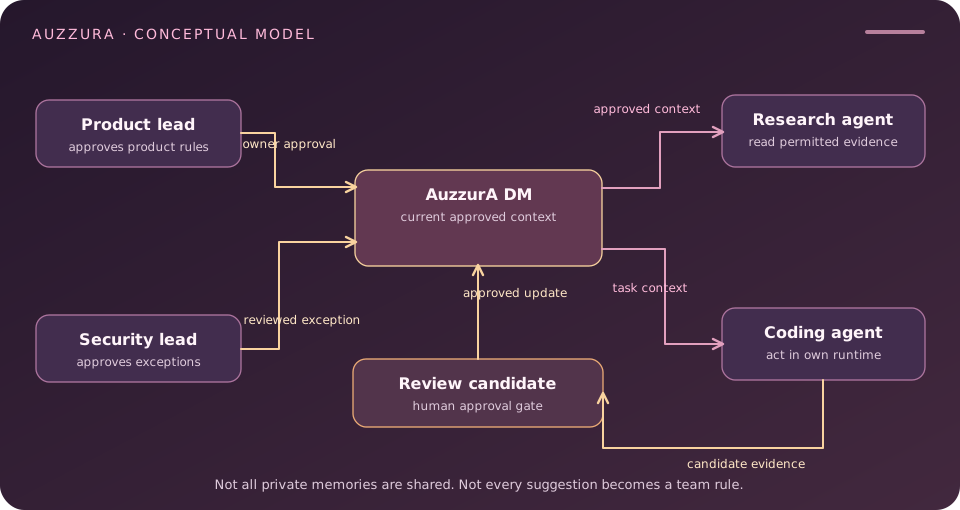
Four boundaries that change with multiple people
The first boundary is identity: the agent must act for a known user or service principal, not as an unrestricted organizational super-user. The second is visibility: one team member’s private notes cannot be silently exposed to another team member’s agent. The third is authority: finding a proposed security exception does not mean that the person requesting work is allowed to approve it. The fourth is lifecycle: a rule approved last quarter may have been superseded today.
Take a customer-support escalation. Support staff record a sensitive workaround for a single tenant; engineering sees a de-identified defect; security approves a production remediation; a coding agent is assigned to implement it. A system that copies everything into a shared agent memory violates the first two boundaries. One that sends only a sanitized task but omits the authorized remediation violates the last two. MAMU requires both restricted handoffs and durable shared commitments.
That is why a multi-user architecture needs a two-way knowledge flow, not simply one context database everyone reads. Agents request the knowledge they are permitted to use; they return observations or candidate changes; authorized humans decide whether those candidates become shared Decisions, Rules or Skills. The next team can then work from a reviewed update without seeing anyone else’s private episode.
Why locally correct agents still produce a globally wrong result
A MAMU environment introduces a problem that single-user multi-agent orchestration can hide. One agent may remember a product promise, another an engineering constraint, and a third a customer-specific exception. Each participant can complete its immediate assignment correctly while the final outcome violates the organization’s cross-team decision.
Imagine a product manager asking a research agent to summarize a feature request. A developer’s coding agent builds the endpoint from that summary. A security reviewer has previously approved the feature only for a limited tenant cohort, but the restriction lives in a separate system. The final result is a coherent implementation of an unauthorized scope. Sending more chat messages between agents is not enough to fix that gap.
A robust handoff distinguishes private observations, shared evidence, approved organizational decisions and task-specific context. The research agent’s summary is potentially useful evidence; the security exception is a reviewed constraint. A connected coding agent should receive the constraint because it is applicable to the task and permitted for its actor, not because another agent happened to mention it.
When the product requirement changes, the return path matters just as much: new observations become candidates; accountable humans decide what becomes durable, shared authority. DM can supply the relevant approved context after review, but it should not be portrayed as autonomously negotiating policy or approving exceptions on behalf of multiple stakeholders.
This clarifies the difference between MAMU governance and ordinary agent-to-agent memory sharing. The additional human users introduce distinct identities, access rights, approval responsibilities and ownership of consequences. Those boundaries need representation even when the agents all appear competent.
A handoff that survives a team change
The product manager approves an API change with two constraints. The implementation agent requests the current rules, modifies the service and reports a compatibility problem. The agent submits evidence and a candidate adjustment. An engineer evaluates the new dependency, security reviews an exception, and a revised decision is accepted or rejected. At the next sprint, a new agent—and a newly hired engineer—can retrieve the decision’s current version and why it changed.
That two-way flow matters. One-way retrieval can supply an agent with yesterday’s policy, but it does not preserve the lessons of today’s work. Unreviewed write-back may preserve lessons but pollute shared policy. The useful middle ground is agent-assisted proposals followed by explicit human review.
Where AuzzurA DM fits in the architecture
DM provides a reviewed context layer for humans and connected AI agents. Its Decisions, Rules and Skills have source evidence and scoped status; Search and Ask DM help people reconstruct why a choice was made, while Prepare Context can supply the applicable material before the next task. Supported MCP access allows an agent to request that context without requiring everyone to keep identical prompt files. Graphify-backed repository intelligence helps when the task depends on codebase relationships.
DM does not orchestrate all agents, grant security permissions in external tools or replace human decision rights. Its episodic Mem0 integration is partial and entitlement-gated, so it should be treated as an evolving capability, not a default shared brain. The value is maintaining continuity across participants while making the trust boundary explicit.
The acceptance test for a MAMU pilot
Ask two humans and two agents to complete one scoped change. Give one participant restricted evidence and introduce a superseded instruction. Can the other participants still complete their part without seeing restricted material or following the old rule? Can the agents return a material new observation without self-approving it? If you can explain those answers from the workflow record, you have begun designing for a MAMU team rather than simply adding more chatbots.
Sources
Put shared context to work.
DM is AuzzurA’s Beta product for human + AI teams. Sign up or sign in through the DM portal.