
The failure that becomes useful memory
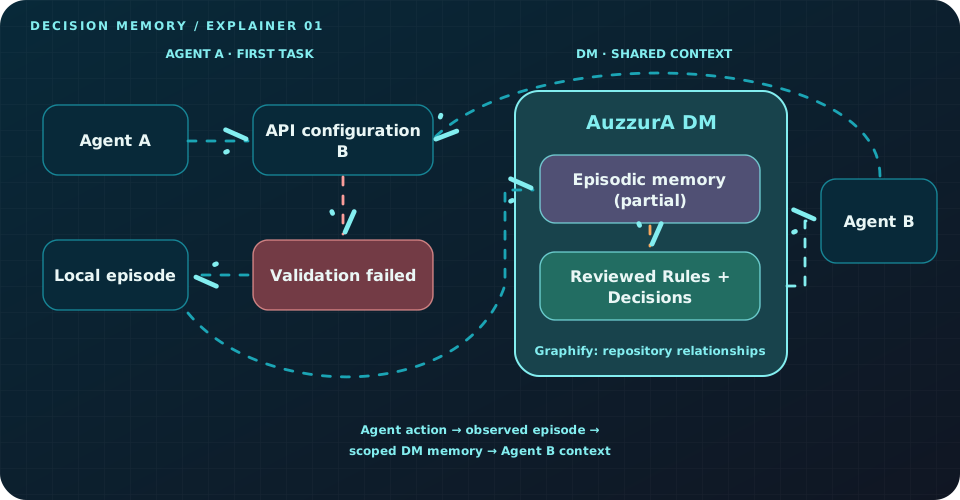
Agent A is configuring an API. It tries configuration B and receives a validation error. The failed call is an event: something that happened. If Agent A keeps only the transcript, a later run may repeat it. If it stores a compact observation—configuration B failed against API version 3 because field X is no longer accepted—it has created useful memory. But Agent B, working on a different API version, should not blindly treat that observation as a universal rule. It needs to know when that memory applies.
That distinction is the heart of the difference: memory retains potentially useful experience; context engineering decides what experience belongs in the next task.
What agent memory actually stores
Agent memory is not one database or one feature. Working state keeps track of the current task. Episodic memory records events, such as the failed API call. Semantic memory can retain a reusable fact, such as the supported configuration for version 3. Procedural memory can describe how to validate a configuration before deployment.
Each type answers a recall question. None, by itself, proves that a remembered fact is current, approved for the organization, or relevant to the next user. A memory from a test environment may even be dangerous when reused in production.
Context engineering asks a different question
When Agent B starts work, its context can include the task, instructions, live API schema, permissions, tool results, retrieved documentation and memories from Agent A. Context engineering is the process of selecting, ordering and maintaining that material so Agent B can take the right action.
For the API example, the resolver checks the endpoint, version, environment and timestamp. If Agent B is on version 3, the failure memory is relevant evidence and the current schema confirms what to use instead. If Agent B is on version 4, the memory becomes a caution to verify—not a prohibition to copy verbatim. The original failure stays visible with its provenance.
From one agent’s experience to team knowledge
In a hybrid team, memory has audiences. Agent A can keep private scratch state while it experiments. A candidate learning may be shared with another agent for the same task. A durable team rule, however, requires stronger evidence, a scope and an owner. An agent’s local observation should not automatically become an organization-wide policy.
The flow is circular: agents act, observe outcomes, propose learning, and later receive selected knowledge as context. The diagram shows both local memory and reviewed shared memory, including how Agent A’s learning can help Agent B without turning every observation into a rule.
How DM Memory and Graphify fit—and what is available
DM’s memory architecture includes an episodic-memory path for what an agent tried, observed and learned. The Mem0 adapter and UI exist, but the provider remains entitlement-gated and not enabled by default; this is a partial/in-progress capability, not a universally available live feature. In a supported configuration, Agent A’s failed configuration B call could become a scoped episode with API version, conditions, outcome and evidence. DM’s live Rules, Skills and Decisions have a separate approval and task-context lifecycle.
Graphify-backed repository intelligence is a live capability: it supplies codebase structure, dependencies and architectural relationships. DM can combine that evidence with approved decisions and relevant memories for a connected task; Graphify itself does not automatically connect every episode to every business decision. DM does not replace working scratch state, live schemas or runtime authorization. The intended flow lets one agent’s experience inform another without automatically making that experience universal policy.
What still needs engineering judgment
Not every failure merits durable memory. A transient timeout may be noise; a reproducible incompatibility tied to a version may be valuable. A good design needs retention rules, duplicate detection, environment scope, conflicts and review triggers. Evaluate it with the question: when Agent B receives this context, does it avoid the old mistake without overgeneralizing the lesson?
Further reading
The scenarios above are illustrative, not customer case studies. Forum posts reflect individual experiences, not representative statistics. DM product capabilities are described as design intent and should be checked against the current release before publication.
Put shared context to work.
DM is AuzzurA’s Beta product for human + AI teams. Sign up or sign in through the DM portal.