
A product team gives an AI assistant access to Confluence through retrieval-augmented generation (RAG). The assistant can now find a design page—but it still forgets what happened in yesterday’s debugging session, and it sometimes cites a proposal the team has already rejected. The team wonders whether to add agent memory, a larger vector database, or a “context engineering” framework. Those are related tools, but they address different failures.
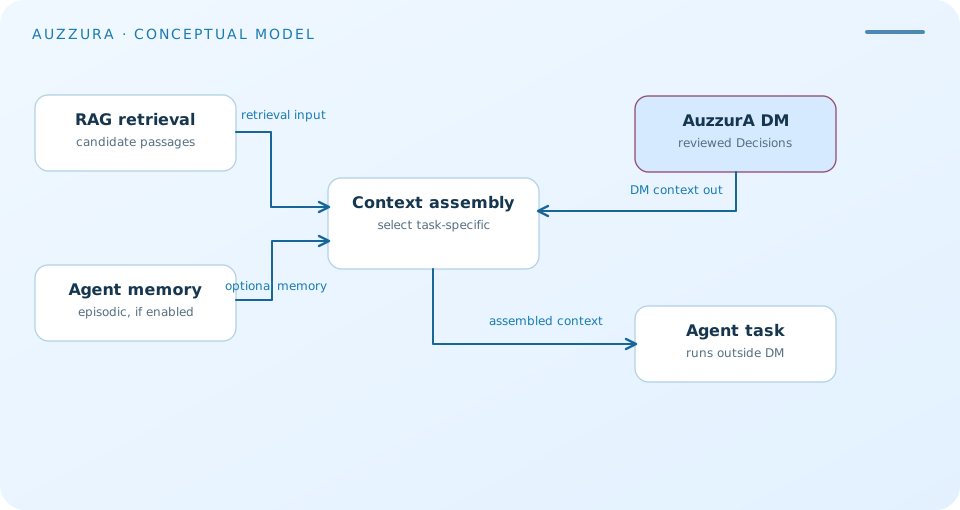
A useful short distinction is: RAG finds source material; memory preserves continuity; context engineering assembles the right information for the current task. The same system may use all three. Treating them as synonyms makes architecture choices expensive and hard to evaluate.
What RAG does, and what it cannot decide
RAG retrieves relevant material at response or task time. It is powerful for answering questions grounded in documents, repositories and knowledge bases. When an engineer asks how a service authenticates, RAG can retrieve the architecture guide and matching code. It can also fail: a relevant page may describe an obsolete design, and a passage ranked highly by similarity may lack approval for this project.
This is not an argument against RAG. It is a reminder that retrieval scores describe a match to a query, not the organizational authority of a statement. Better indexing improves coverage; it does not by itself establish which conflicting source governs production.
What memory adds
Memory supports continuity across steps and sessions. An agent can retain that a particular API configuration failed, what environment caused the failure, or which approach a user preferred. This can prevent repeated exploration and let work resume after a handoff. Yet an episode can also mislead. A workaround successful on a staging cluster should not be copied automatically into another product’s production architecture.
A memory entry therefore benefits from provenance, scope, expiration and a way to distinguish raw experience from approved shared knowledge. For multi-user work, privacy boundaries matter just as much as persistence.
What context engineering decides
Context engineering is the broader design of what reaches the model or agent for a particular action. It combines instructions, retrieved sources, relevant memory, tools, task state, permissions and available token budget. It asks not merely “Can we find this information?” but “Should this participant use it now, in this environment, for this objective?”
Imagine an agent implementing a new payment endpoint. RAG finds the API specification. Memory recalls a prior integration failure. Context engineering checks the current service version, selects the approved retry policy, excludes a superseded example and gives the agent enough evidence to work. Those steps make the three components complementary rather than competing.
Where DM strengthens the workflow
AuzzurA DM focuses on the organizational part of context: what the team has approved, why it was approved, and where it applies. Reviewed Decisions, Rules and Skills provide a more durable reference than an isolated retrieved paragraph. Search and Ask DM can help reconstruct that history; Prepare Context can present relevant, permitted records to connected agents. Live Graphify-backed repository intelligence contributes dependency and architecture context when the task involves code.
The memory layer should be described accurately: DM’s Mem0-based integration is partial and entitlement-gated, not universally on. DM does not replace every vector index or agent runtime. It helps bridge retrieval and continuity with human-reviewed organizational context so a technically correct answer is less likely to be wrong for the team’s actual decision.
Choose by failure mode, not fashion
If the agent cannot find a known document, investigate retrieval coverage. If it repeats the same discovery every session, investigate memory. If it finds both the current and rejected approaches but chooses the wrong one, investigate eligibility, authority and context selection. Use one reproducible task for the comparison and track how the next run changes. The strongest architecture is the smallest one that fixes the actual failure.
A failure matrix for architecture decisions
The three approaches can fail independently. RAG failure: the right runbook exists but the index misses it. Improve document coverage or query strategies. Memory failure: the agent rediscovers a previously solved compatibility issue every session. Retain the episode with its environment and outcome. Context-selection failure: the agent retrieves both an accepted rule and a rejected proposal, then follows the proposal. Make the approved status and scope explicit before execution.
Many teams begin by adding more retrieval or longer persistence to all three cases because those are easy features to purchase. A more disciplined evaluation runs one repeatable task, labels the failure at the correct layer, and measures whether the targeted fix changes the outcome. The architecture remains simpler, and the business case becomes easier to explain to a lead engineer.
Sources
Put shared context to work.
DM is AuzzurA’s Beta product for human + AI teams. Sign up or sign in through the DM portal.