
An engineering agent receives a question: “Why is the checkout service still using the old token exchange?” A vector database finds a paragraph mentioning “token exchange,” but the explanation depends on relationships: checkout calls a shared identity service, the identity service is constrained by an architecture decision, and a replacement policy applies only to the next release. Search returns pieces of the story; the team needs to connect them.
Vector indexes and knowledge graphs solve different retrieval problems. A vector database helps find semantically similar content. A knowledge graph represents named entities and relationships that can be traversed. Neither is a built-in truth engine. The choice should follow the questions your agents need to answer and the quality of the evidence available.
When semantic similarity is enough
If a developer asks “How do I rotate an API key?” a good document index may retrieve a precise runbook. Vector search is especially useful when the question uses different wording from the source, and it can complement exact keyword search. It is not obligated to represent every service dependency or approval relationship. For many teams, hybrid retrieval over well-maintained documents is a strong starting point.
The failure mode appears when the answer is distributed across documents. A similarity search can find both the proposed and accepted migration plan without knowing which one superseded the other. More embeddings may improve recall without resolving that ambiguity.
When graph relationships earn their complexity
Graphs become useful for traversing explicit questions: Which services depend on API v2? Which ADR applies to those services? What decision replaced the original choice? Which evidence supports a policy? A graph can make these steps predictable when nodes and edges are maintained accurately.
But a graph also introduces risks: stale edges, uncertain entity matching, inferred relationships mistaken for facts, and more work to keep the model current. A relation called “related to” may be too vague to support an engineering decision. If the graph cannot explain why its edge exists, an agent might mistake an attractive visualization for verified evidence.
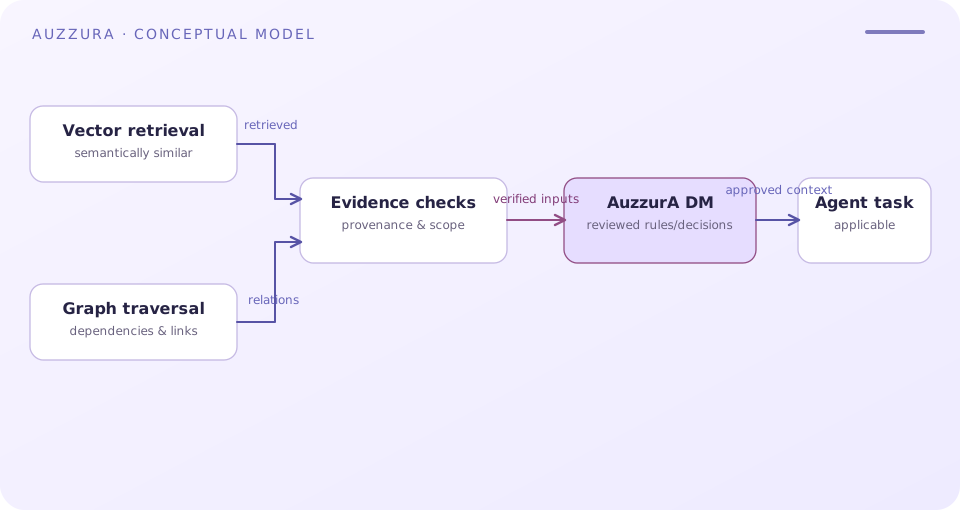
The practical answer is often both—plus a review step
For checkout’s token exchange, semantic retrieval finds the migration notes and error reports. Repository dependency analysis reveals which services call the identity API. Reviewed decision records establish that the old exchange remains permitted for one environment until a planned replacement. An assembler chooses the relevant pieces for the current task rather than loading an entire graph neighborhood or document archive.
This architecture can begin modestly: a document store, a small set of typed links and an owner for important decisions. A large graph platform is not a prerequisite. Add graph traversal when repeated questions demonstrate that text retrieval cannot reliably expose dependencies or succession.
Not every graph edge is trustworthy
A graph is useful only when its relationships mean something precise. Consider a dependency edge discovered from a repository: CheckoutService → calls → IdentityAPI. The evidence is code, and the team can check it against a particular commit. Now consider a second edge inferred from a meeting: IdentityAPI → approved by → SecurityTeam. Mere attendance at a meeting does not establish approval. A model might infer the edge, and a graph may render it beautifully, but neither makes it authoritative. That second edge needs source evidence and an explicit review decision.
This difference matters when the next agent traverses the graph. If it treats both edges as equal, it may accurately trace service dependencies while inventing organizational permission. Preserve edge provenance, temporal validity and relationship types such as calls, constrained by, proposed by and supersedes. An unverified inferred link should remain a candidate, not become an approved fact.
Test with a multi-hop engineering question
Before buying graph infrastructure, write down a question no single document answers: “If Identity API v2 is retired, which services must change, what architecture decision applies, and who can approve the exception?” Verify the answer with code owners and reviewed records. Compare keyword/vector retrieval with graph-assisted retrieval on that same query. Measure whether the graph recovers correct, evidenced links, not how many nodes it can draw.
If a graph misses a dependent service, the issue may be repository coverage. If it finds a superseded decision, the issue is lifecycle handling. If it invents an approver, the issue is authority verification. This test separates useful relationship intelligence from decorative visualization.
Where AuzzurA DM contributes
DM has live Graphify-backed repository intelligence for codebase, architecture and dependency context. That answers a real kind of graph question in engineering workflows. DM also offers reviewed Decisions, Rules and Skills with evidence, scope and lifecycle. The combination matters when a repository relationship tells an agent what could be affected, while a reviewed decision tells it which change is allowed or appropriate for this project.
This does not mean DM has a complete knowledge graph of an entire enterprise, or that it replaces every vector database. Nor does a relationship automatically confer approval. The useful proposition is that a developer and an AI agent can connect repository understanding with the team’s current, approved reasoning without reconstructing it from scattered documents.
Test on two questions
Choose a straightforward document question and a dependency/change-impact question. Compare a vector-only answer with a graph-assisted answer, scoring missing evidence, wrong-scope recommendations and explanation quality. If a graph adds no useful relationships, defer it. If semantic retrieval cannot connect the services and the governing ADR, add typed relationships with source provenance and measure the difference.
A concrete data model for one engineering decision
A minimal hybrid need not be an enterprise ontology. Start with Document, Service, API, and Decision entities, and a few typed relations: calls, documents, constrained_by, and supersedes. Each edge should reference the file, commit or reviewed decision that justifies it. Embeddings can still index the long explanations, while the typed links let a query traverse from a service to the decision governing it.
The hard part is change management. When an ADR is replaced, update its status and link the successor. When a service is renamed, preserve an alias or migration trail. When an AI model suggests a new relation, mark it as inferred until validated. That discipline is what makes a knowledge graph useful to an agent rather than merely attractive in a diagram.
Sources
Put shared context to work.
DM is AuzzurA’s Beta product for human + AI teams. Sign up or sign in through the DM portal.