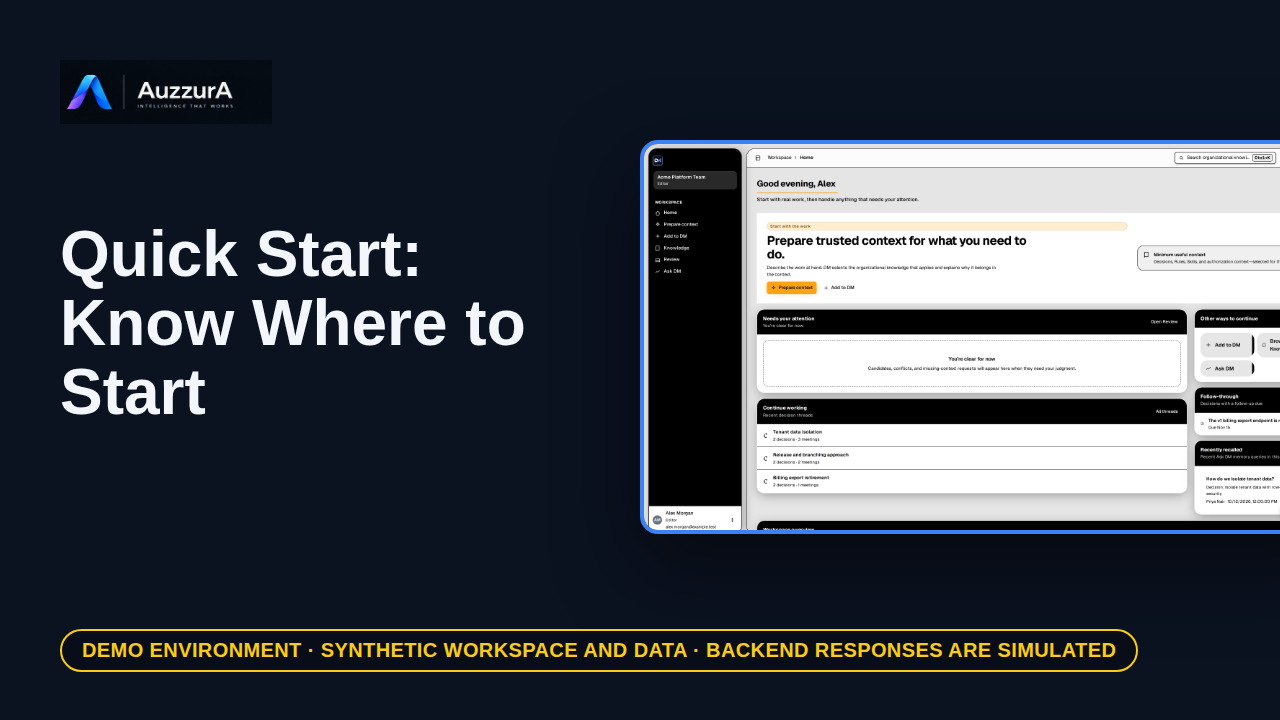
Know where to start
Know the three places you will use: the Home queue, Add to DM and Knowledge. Three places are enough to get started.
For: Any signed-in workspace member
How-to
A decision candidate with its rationale is saved for review. Write the decision first. Add the reason while it is fresh.
Read the steps OR watch the video. Both teach the same outcome, and neither is needed for the other.Jump to the video
Guided Quick Start
Follow the sequence or jump to any lesson. Every step also works on its own, with written instructions alongside the optional video.
Step 3 of 6
What it means: To record a decision, select Add to DM.
What it means: You already know the decision, so choose Create directly.
What it means: Choose Decision.
What it means: Write the decision as a statement.
What it means: Then add the reason behind it.
What it means: Then submit it.
What it means: Your decision is saved as a candidate for review. It isn't team knowledge until a person approves it. Next, approve it.
Source-based intake (pasting notes or attaching files) is a different route, covered by the Add your first evidence episode.
The Optional details section (owner, follow-up and the other advanced fields) is not opened in this Quick Start; a separate, focused tutorial would explain each field.
Rules, Skills and Action items, the other things Create directly can record, are not shown.
What happens in a real deployment after submitting, including the checks on the candidate, was not verified.
Demo environment · synthetic workspace and data · backend responses are simulated. Quick Start 3 of 6
The submission is SIMULATED: this guide uses the real DM Create directly form with a synthetic workspace, and the response that creates the review candidate is fixture data, not a deployed backend. Nothing is approved or becomes durable knowledge in this clip. Quick Start clips 1 to 6 follow one example workspace, Acme Platform Team.
A banner reading "Demo environment · synthetic workspace and data · backend responses are simulated" stays on screen for the whole video.
On screen: Start on DM Home (/). Click "Add to DM". The next view is "Add to DM" (/add). A highlight marks "Add to DM".
Narrator: To record a decision, select Add to DM.
On screen: Click "Create directly". The next view is "Create directly" (/add/create). A highlight labelled "Create directly" marks "Create directly You know exactly what to author — one Decision, Rule,…".
Narrator: You already know the decision, so choose Create directly.
On screen: Click "Decision". The next view is "Intake" (/intake). A highlight labelled "One decision" marks "Decision".
Narrator: Choose Decision.
On screen: Type "Any migration that touches production schema needs approval from two reviewers." into the "Decision statement *" field. A highlight marks "The decision". Afterwards: A highlight marks "The decision".
Narrator: Write the decision as a statement.
On screen: Type "A single-reviewer migration dropped an index in the spring." into the "Rationale (optional)" field. A highlight marks "The reason". Afterwards: A highlight marks "The reason".
Narrator: Then add the reason behind it.
On screen: Click "Create proposal →". The next view is "Production schema changes" (/candidates/cand-two-reviewers/review). A highlight labelled "Submit" marks "Create proposal →".
Narrator: Then submit it.
On screen: A highlight labelled "Your candidate" marks "Any migration that touches production schema needs approval from two…".
Narrator: Your decision is saved as a candidate for review. It isn't team knowledge until a person approves it.
Narrator: Next, approve it.
Last verified against the product on .
Know the three places you will use: the Home queue, Add to DM and Knowledge. Three places are enough to get started.
For: Any signed-in workspace member
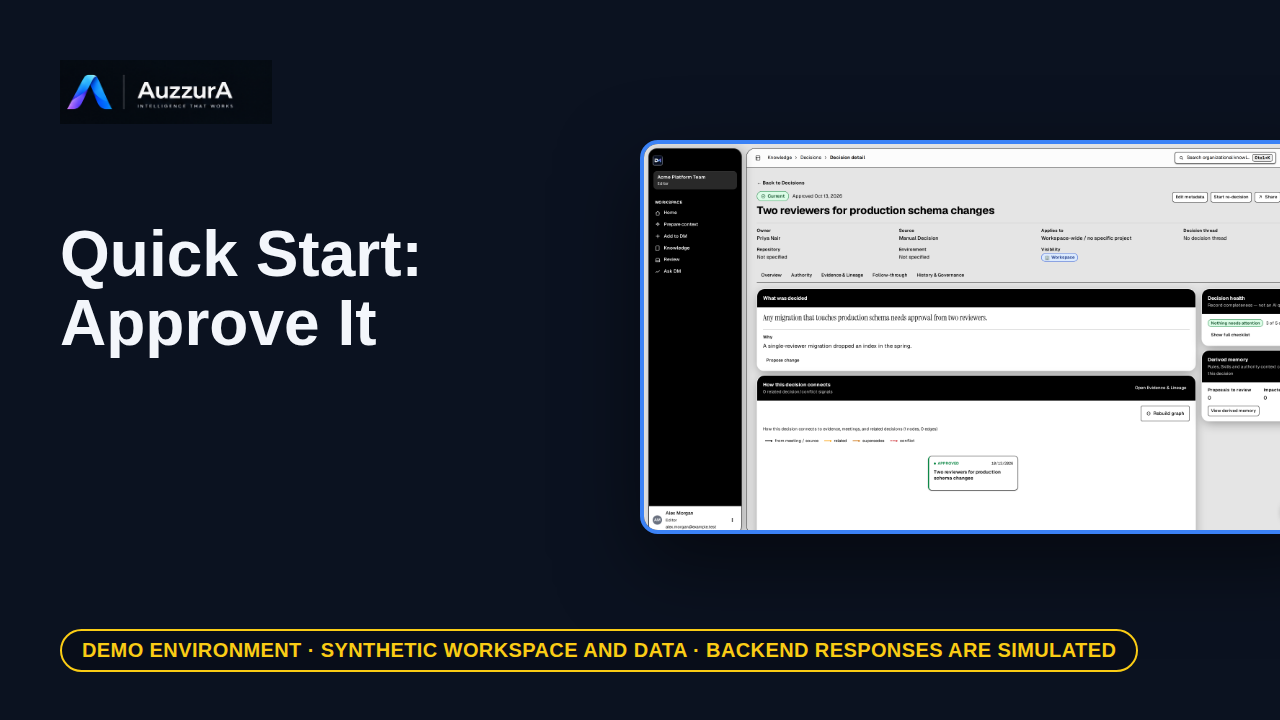
The candidate becomes approved team knowledge. Until a person approves it, it is only a proposal.
For: Reviewer or workspace decision owner
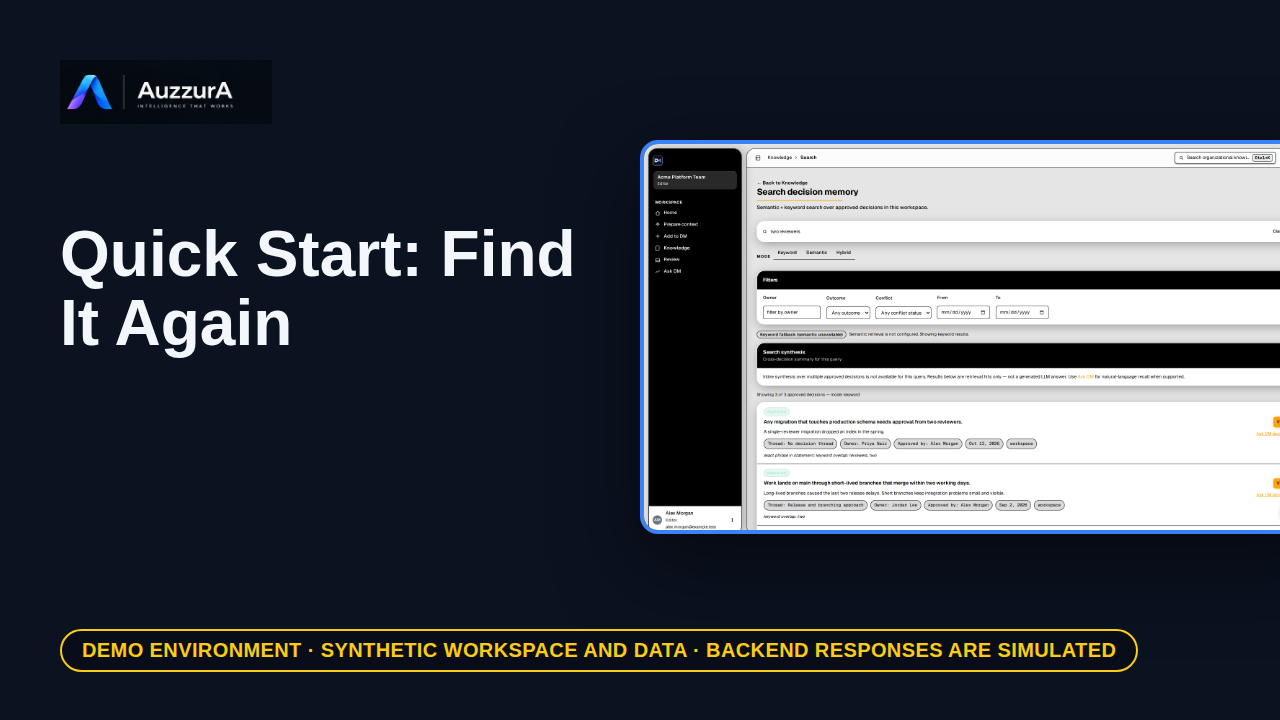
Find the decision, its reason and its evidence. Months later, search beats remembering.
For: Any authorized workspace user
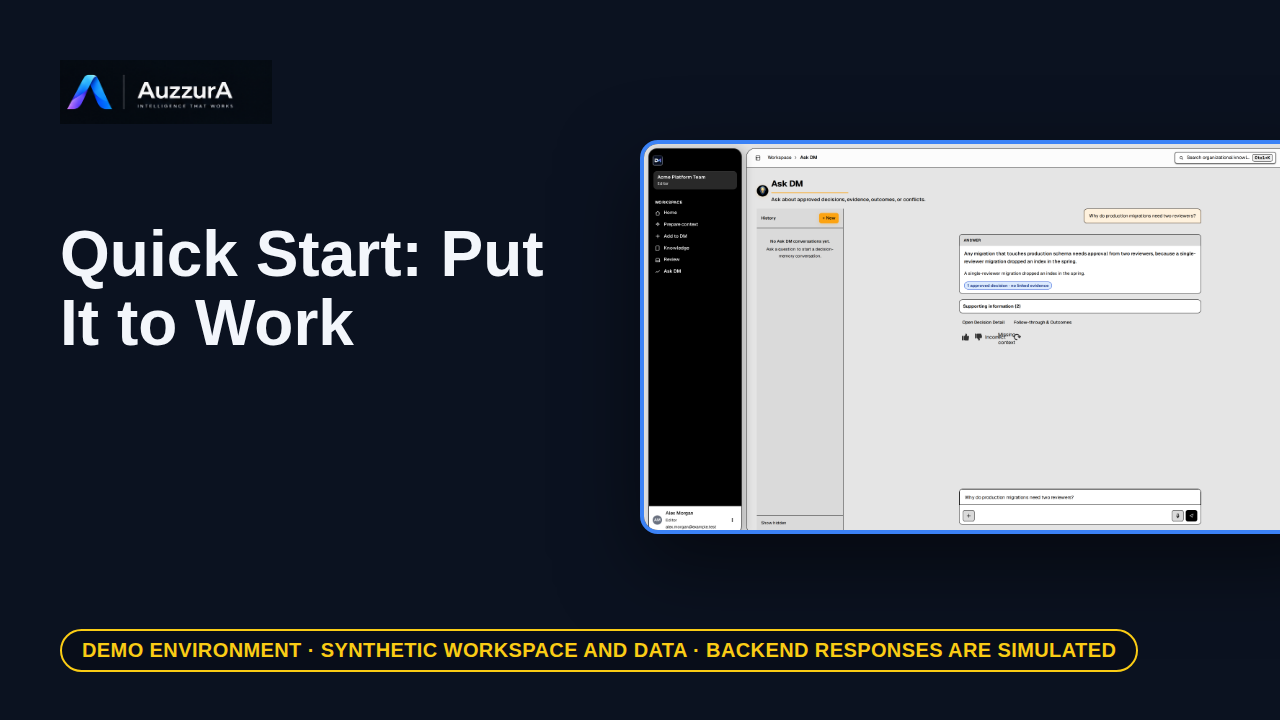
Ask DM from the decision, and hand it to an agent task as context. An approved decision is only useful if it is used.
For: Workspace member and agent user