
You ask a coding agent: “Build a website that promotes our new product.” The instruction is understandable. The agent can produce a functioning page, write a confident headline and choose a contemporary color scheme. Yet the result is wrong for your company: it uses generic purple gradients, invents a paid checkout the company does not offer, and describes a planned feature as generally available.
The agent did not necessarily misunderstand the prompt. It was never given the organizational information needed to do the job as your team intended. That is the practical difference between prompt engineering and context engineering. To understand why the same clear request can produce two very different outcomes, let’s start with the definitions.
Start with the definitions: instructions and actionable information
Prompt engineering is the craft of formulating the model’s instructions: the task, desired behavior, constraints expressed to the model and expected output. It answers “What should the model do, and how should it respond?” A better prompt might say, “Write accessible Astro components, use semantic headings, avoid unverified product claims and provide a change summary.”
Context engineering is the process of selecting and maintaining everything the model needs at the moment of work: instructions, relevant files, live tool results, state, organizational decisions, examples, permissions and possibly memory. It answers “What does the agent need to know, what is currently true, and why does this information apply?” Context can fill information gaps the user did not know to express in the prompt.
These are not competing technologies. The prompt is part of the context. The distinction is about engineering responsibility: refining wording cannot repair missing, conflicting or stale facts. Anthropic similarly describes context engineering as managing the broader model input, beyond instruction wording, as agents operate over longer tasks.
Return to the website request. The agent knows what to build, but not which company-specific facts should guide its choices. The contrast in the figure becomes clearer once we examine those missing decisions.
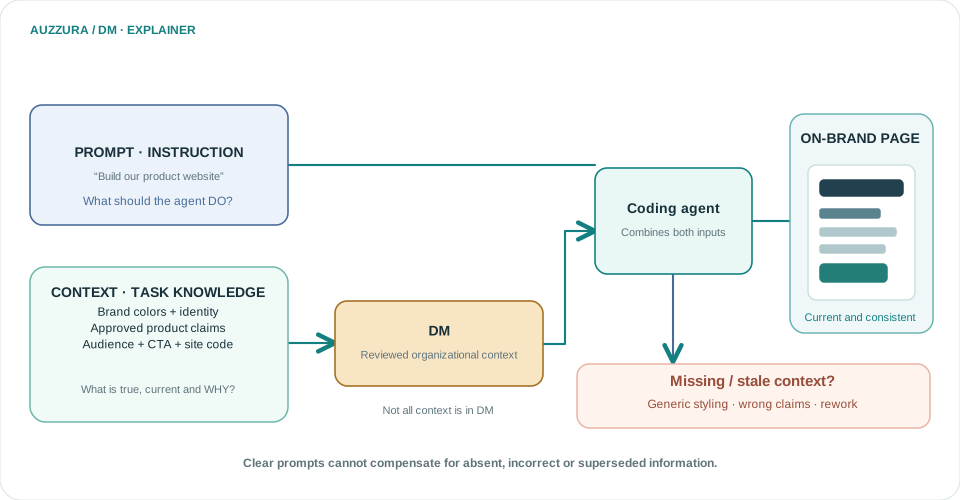
Follow the website request through five missing decisions
The user gave the agent an outcome: promote a product. Translating that outcome into an acceptable website requires answers to several organizational questions. Five of them were missing:
- Brand identity. Which typefaces, colors, logos, spacing and illustration style constitute the company’s identity? A user may remember “dark blue” but not know which contrast and component rules the site actually uses.
- Product truth. Which capabilities are live, partly available or planned? A persuasive launch page cannot treat all three as equally shipped.
- Audience and voice. Is the page for individual builders, engineering leaders or procurement teams? A technically correct feature list may still communicate to the wrong buyer.
- Approved conversion route. Does the site offer immediate signup, early access or a sales conversation? A generic call to action can create a broken user journey.
- Existing implementation. Which routes, components, asset paths and design tokens already exist? Rebuilding from scratch may violate maintainability and accessibility decisions.
The five questions point to an underlying problem: these details may be scattered across a design system, a product document, a decision log, previous website work, a repository and a recent meeting. Some have formal owners; others are merely suggestions. Copying everything into the user’s prompt every time is neither realistic nor sustainable.
That brings us to the risk of a seemingly useful instruction. This is why the instruction “follow our brand” is insufficient. The agent needs the applicable brand decisions and files, including whether an older identity document was superseded. If the supplied context incorrectly says “purple is our brand color,” a powerful agent may now produce the wrong design more consistently. Bad context can make an agent confidently efficient at the wrong task.
Turn missing knowledge into a task-ready context package
So how does a team provide the missing information without writing a new encyclopedic prompt? The answer is a repeatable context-engineering sequence.
Start with a task frame: build a launch page for this product, in this repository, for this audience, with a human reviewer and clear acceptance criteria. The frame makes retrieval discriminating: it should not pull every marketing document ever written.
Once the task is clear, establish eligibility and authority. Can this agent access the design system? Which product status document is current? Is the proposed pricing copy approved or only under discussion? A search result can be relevant but still be stale, restricted or nonbinding.
Only after those boundaries are known, retrieve the necessary working material: actual Astro components, the current palette and typography, the approved product description, the canonical CTA route and perhaps a previous design decision explaining why a visual was rejected. Include references so the human can inspect the evidence rather than trusting an opaque summary.
With those sources checked, compose a small task-ready context package. It might say: “Use the existing visual tokens from these files; the only supported CTA is Create a DM account; feature X is partial; preserve these routes; follow this approved headline.” Add the current repository state and the original user instruction. Now the agent can act with both direction and grounded information.
After the agent acts, inspect the result. If the website is off-brand, distinguish whether the prompt was ambiguous, the right context was missing, the wrong source was selected or the agent failed to obey correct context. Those failures require different fixes. More prompt adjectives will not solve a retrieval or freshness defect.
Why not put all organizational knowledge in the prompt?
The process above may sound like extra engineering. Couldn’t the company simply paste its brand rules and product decisions into a very long system prompt?
You can paste current brand rules and decisions into a prompt. For a one-off experiment, that may be enough. For a company with multiple agents and people, that approach becomes brittle. Instructions are duplicated across agents and repositories; product claims change; exceptions are scoped to one campaign; employees forget context or describe it inconsistently; and long prompts can carry mutually incompatible versions.
A sustainable design separates stable behavior instructions from evolving organizational facts. The prompt can remain: “Build an accessible launch page and cite the sources you used.” A separate context process supplies the current approved identity, claims and project constraints for that particular job. It can explain why an item was included and why another was excluded.
The important upgrade is not simply automatic retrieval. It is deciding which retrieved material is permitted, current, approved and relevant before presenting it as guidance.
Where DM helps—and where it does not
That separation between reusable instructions and changing organizational facts creates a specific coordination problem: who maintains the shared facts, and how do multiple agents receive the right version? This is where a reviewed context layer can help.
DM helps human and AI teams keep reviewed Rules, Skills and Decisions available as shared organizational context. Its live preparation and MCP paths can give connected agents a relevant context package instead of asking every user to remember and restate the same decisions. In the website example, a reviewed CTA decision and approved product positioning can travel with the task; a superseded campaign draft should not silently override them.
Graphify-backed repository intelligence adds live codebase, dependency and architectural evidence when the task involves software. It may help the agent find the site’s existing components and relationships. Episodic memory through Mem0 remains partial and entitlement-gated; do not assume that every agent experience is automatically remembered or shared. DM does not replace the actual design files, a strong task prompt, a human art director or runtime controls that govern what tools the agent may execute.
The complete result still needs human review. A useful outcome of that review is a proposed correction to shared context—say, a newly approved accessibility pattern—not an automatic promotion of whatever the agent just did into company policy.
Test the difference on a real task
The concepts become easier to evaluate when they affect an actual outcome, not just a diagram.
Give two coding agents the same clear website prompt. Give one only the instruction. Give the other a concise, verified package containing current brand tokens, product status, CTA decision and repository context. Compare the resulting pages on brand fidelity, unsupported claims, rework and the ability to explain each choice. Then deliberately insert one obsolete brand rule to see whether your context process rejects or flags it.
The takeaway is practical: the prompt tells the agent what to do; context makes that instruction executable in the reality of your team. Strong agent systems need both—and must be able to detect when their context is wrong.
Sources and further reading
- Anthropic Engineering — Effective context engineering for AI agents
- Anthropic documentation — Prompt engineering overview
- Architecture Decision Record guidance
The website scenario is illustrative. DM product claims follow the current AuzzurA Promotion SSOT and must be release-checked before publication.
Put shared context to work.
DM is AuzzurA’s Beta product for human + AI teams. Sign up or sign in through the DM portal.